

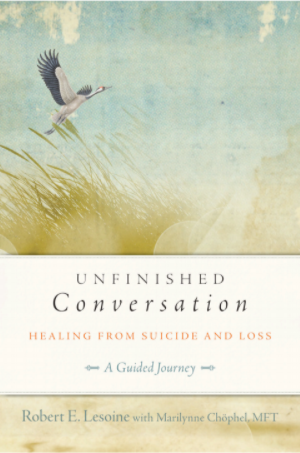
Unfinished Conversation Book

Unfinished Conversation
Healing from Suicide and Loss-A Guided Journey

Robert E. Lesoine
With Marilynne Chöphel, MFT

Order online:
Parallax Press
Amazon
Barnes and Noble
Indiebound
And at booksellers everywhere

Unfinished Conversation chronicles a path of transformation from anger and despair to compassion and liberation.”
—Zen Master Thich Nhat Hanh, Being Peace

“Beautifully written, this book is pure medicine for the grieving heart.”
—Tara Brach, PhD, Radical Acceptance and True Refuge

“This eloquent book is a personal companion for those left behind, a friend nudging us forward with compassion and wisdom.”
—Christopher Germer, PhD, Clinical Instructor, Harvard Medical School, author of The Mindful Path to Self-Compassion

“Expertly woven into the raw feelings expressed in the journaling of Lesoine’s loss are the tools and techniques that will help to understand, heighten, experience and refine these emotions. The authors claim this journey will help anyone left after a suicide find greater perspective, meaning, and wellbeing in their lives. I agree without reservation… Unfinished Conversation is a book that I will use in my own clinical practice and one that I will recommend to friends and family. The book helps to create some understanding out of an experience that is largely devoid of it. Most importantly, the book helps to believe that there really is hope that it gets better.”
—American Association of Suicidology

More Endorsements

Book Reviews

Authors’ Acknowledgments

Facts about Suicide in the Military

From the Department of Defense/Veterans Administration Suicide Outreach

On average, 18 veterans per day take their own lives.

Of all active duty suicides between 2003 and 2009: 94.4% were male; modal age was 21; 74.3% were Caucasian; 52.1% were married; 57.1% were junior enlisted; 20.7% were in the infantry; 83.3% were Active Component; 69.3% had one or more deployments.

Historically, the Army suicide rate has been significantly lower than the civilian rate (the civilian rate, demographically adjusted, is typically about 19.2 per 100,000). However, suicide and accidental death rates began trending upward in 2004, and in 2008, the Army suicide rate crested above the national average and reached a record of 20.2 per 100,000.

Veterans aged 20 through 24, those who have served during the war on terror, had the highest suicide rate among all veterans, estimated between two and four times higher than civilians the same age. (The suicide rate for non-veterans is 8.3 per 100,000, while the rate for veterans was found to be between 22.9 and 31.9 per 100,000.)

For every suicide death in 2009, at least five members of the armed forces were hospitalized for attempting to take their life.

A 2007 CBS study put the suicide rate among male veterans aged 20 to 24 at four times the national average—more than 40 per 100,000 per year.

The Department of Veterans Affairs reported in January 2010, that the suicide rate among 17 to 29-year-old male veterans jumped 26 percent from 2005 to 2007.